
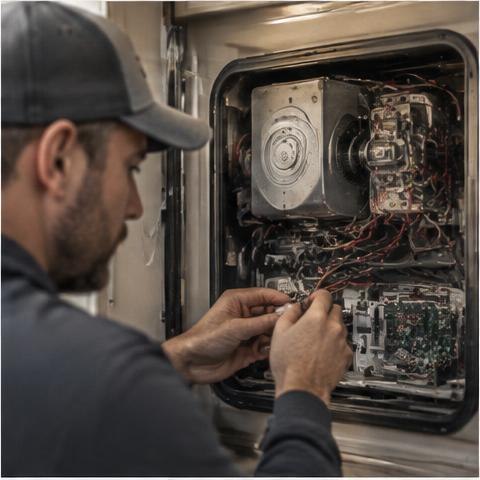
If your RV furnace will not light at elevation, start with the simple checks: battery voltage, propane supply, thermostat settings, and the outside vent. High altitude and cold nights can expose a weak system, but they are not proof of a specific failure.
Start with safe, simple checks
Confirm the thermostat is set to heat and the temperature is above the room temperature. Check that the propane supply is on and other propane appliances work. If the furnace fan does not run, check your battery charge and the relevant fuse. If you smell propane, stop and seek professional help rather than repeatedly trying to ignite the furnace.
Listen to what happens
A fan that runs without heat tells a different story from a furnace that does nothing at all. Note whether you hear the blower, any clicking, and whether the unit tries more than once. These observations can help a technician narrow the diagnosis without asking you to take apart a gas appliance.
Why mountain conditions matter
Around Silverton and the San Juans, cold nights increase demand on heating systems. Elevation can affect combustion, while boondocking can leave the battery lower than expected. A low battery may run lights but still struggle with the furnace startup sequence.
When to call a technician
If the furnace repeatedly fails to ignite, shuts off quickly, or produces unusual smells or sounds, stop troubleshooting. A certified RV technician can check the appliance and its electrical and fuel systems on site.
Check the battery under load
An RV furnace is not simply a propane burner. The blower and controls also need electrical power to complete a safe ignition cycle. A battery monitor can show a reassuring number while the battery struggles as soon as the blower starts. If you have a reliable way to read battery voltage, compare the reading before and during a heat call. Avoid bypassing any safety switch or attempting to jump wires to make the furnace run. If the battery is low, restore a dependable charging source and try again according to the furnace manual. If the problem persists, the electrical side needs a closer look.
Verify propane without guessing
If another propane appliance works, that is useful information, but it does not prove everything is right at the furnace. Note whether the cooktop lights normally and whether the tank has fuel. A recently changed tank or a long period without use may leave you with a different problem than one that began mid-trip. Do not open propane fittings or use a flame to check for leaks. If you smell gas, turn off the supply if safe to do so, leave the area, and get professional assistance. The technician can test supply and ignition safely.
Look at the outside vent
Locate the furnace exhaust on the outside of the RV using your manual. From the ground, look for obvious leaves, snow, or campsite debris nearby. Keep the area clear, but do not push anything into the opening or disassemble the vent. A blocked exhaust can prevent safe operation, and removing a visible obstruction may not address the underlying fault. Do not cover the vent to keep out cold air while the furnace is in use. If soot, damage, or repeated shutdown appears, stop using it until someone checks the system.
Write down the symptoms
Before calling, make a short note of the RV make and model, the furnace model if accessible, the elevation and overnight temperature, and what happened when you turned up the thermostat. Did the blower run? Was there an ignition click? Did it light briefly and then stop? Did the problem begin after travel, tank replacement, or several nights off-grid? Specific observations save time and help distinguish a power problem from an ignition or airflow problem. A photo of a displayed fault code is useful, but do not remove panels solely to find one.
Plan for the next cold night
If the furnace is unreliable, make a safe alternate plan before the temperature drops. Never use an outdoor grill or an unvented device inside an RV as a substitute. Check your carbon monoxide and propane alarms according to their manuals, and know where your shutoff valves are. Keep your batteries charged and note when a charging source stops working. A little preparation matters when camped far from town. Merrick can inspect the furnace at your site instead of asking you to move an RV with a problem.
What to tell the technician
Let Merrick know whether you have shore power, a generator, or only batteries, and whether the refrigerator or stove is also having trouble with propane. If the fan comes on but heat never follows, say how long the fan ran. Note whether the furnace worked before you reached higher elevation or before the last tank change. These details do not replace testing, but they can focus the visit. If you have a photo of the furnace label or a visible code, keep it handy. Do not remove a sealed panel or work on the gas line to collect information. The safest useful preparation is a clear description of what you observed and a safe, accessible parking spot for the service call.
Get help where you are.
When simple checks are not enough, Merrick can come to your RV in the Four Corners. Call (855) 760-0891 to describe what is happening and where you are parked.